
It was the final leg of a five-nation European tour, and the first bilateral visit by an Indian Prime Minister to Italy in 26 years. The agenda was packed: trade targets of 20 billion euros by 2029, a new defence roadmap, cooperation in space, AI, and critical minerals. But none of these weighty matters would dominate headlines or capture the public’s heart. Instead, a small, golden-brown toffee, a Colosseum selfie, and a playful internet meme stole the spotlight and created a moment of pure, unscripted joy that the world could not stop watching.
A Welcome Like No Other: The Colosseum, Dinner, and a Selfie
Prime Minister Narendra Modi arrived in Rome on the night of Tuesday, May 19, 2026. This was no ordinary diplomatic reception. Italian Prime Minister Giorgia Meloni personally welcomed him. She hosted a dinner for the visiting leader and then accompanied him on a late-evening walk through the Colosseum, the ancient amphitheatre that has stood as a symbol of Rome for two thousand years.
The images that emerged from that evening were striking. The two leaders stood side by side inside the floodlit monument, deep in conversation. Meloni then shared a selfie with Modi on social media, a picture of two world leaders smiling against the backdrop of ancient stone. Her caption was simple and warm: "Welcome to Rome, my friend!".
Modi, in turn, shared photographs from the dinner and the walk, writing, "Upon landing in Rome, had the opportunity to meet Prime Minister Meloni over dinner followed by a visit to the iconic Colosseum. We exchanged perspectives on a wide range of subjects. Looking forward to our talks today, where we will continue the conversation on how to boost the India-Italy friendship". The two were also seen sharing a candid car ride through the streets of Rome, a moment of informal “car diplomacy” that showed the genuine comfort between them.
The Gift That Broke the Internet
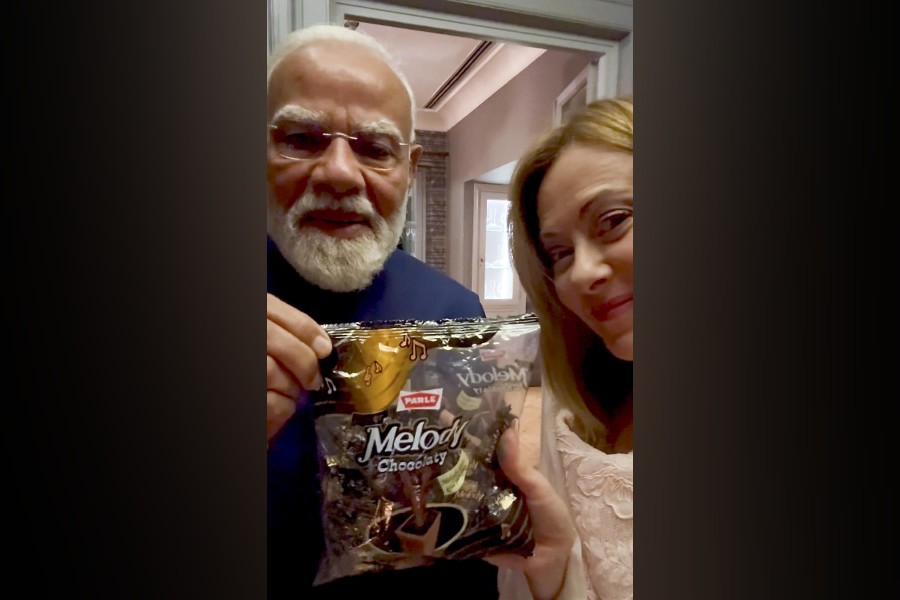
The next day, May 20, during their official engagement, a moment occurred that would define the entire trip. Meloni shared a 12-second video on her social media accounts. In it, she faced the camera, smiled broadly, and said, "Prime Minister Modi brought us a gift… a very, very good toffee." Modi, standing beside her, held up the packet and said, "Melody." Both leaders then burst into laughter.
The gift was a simple packet of Melody toffees, a chocolate-caramel candy made in India by the Mumbai-based company Parle Products. The wordplay was obvious and delightful. "Melody" sounded almost exactly like "Melodi," a viral internet nickname created years earlier by blending the surnames of the two leaders: Meloni and Modi.
Meloni captioned the video simply: "Thank you for the gift.". The internet erupted instantly. Within about six hours, the video had crossed 110 million views on Meloni's social media accounts, along with tens of thousands of reposts.
The Birth of "Melodi": A Three-Year-Old Meme Comes Full Circle
To understand why this moment hit so hard, one has to go back to September 2023. During the G20 Summit in New Delhi, photographers captured Modi and Meloni in several warm, candid moments. Laughter, shared glances, and easy body language sparked a wave of playful speculation online. Social media users in India created the hashtag "Melodi" and began making memes, often borrowing the exaggerated romantic tropes of Bollywood cinema to imagine a fictional love story between the two leaders.
The meme exploded again in December 2023 at the COP28 climate summit in Dubai. Meloni herself leaned into the joke, posting a selfie with Modi and captioning it "Good friends at COP28 #Melodi." The post gathered 23.9 million impressions in less than 24 hours. Modi reposted it, writing, "Meeting friends is always a delight".
From that point on, every meeting between the two leaders reignited the "Melodi" trend. At the 2024 G7 Summit, Meloni shared a selfie video with Modi, acknowledging the meme makers directly. The hashtag became a permanent part of the internet's vocabulary for the India-Italy relationship.
When Modi handed over a packet of Melody toffees in May 2026, he was not just giving a candy. He was winking at three years of shared internet history. The meme had come full circle, and it was now blessed at the highest level of diplomacy.
The Toffee Itself: A Slice of Indian Nostalgia
For millions of Indians, the choice of Melody was deeply personal. The toffee, launched by Parle Products in the early 1980s (around 1983), was a childhood staple for an entire generation. It was a clever hybrid: a chewy caramel coating on the outside, with a core of soft chocolate inside. At a time when imported chocolates were expensive and out of reach for most Indian households, Melody offered a small, affordable indulgence.
The brand's unforgettable advertising slogan, "Melody itni chocolaty kyun hai?" (Why is Melody so chocolaty?), became a piece of Indian pop culture and stayed there for decades. Generations of Indians grew up buying the toffee from neighbourhood kirana stores with pocket money, receiving it as loose change, or finding it hidden in grandmothers' jars.
By the 2000s, changing tastes and global competition pushed the toffee to the background. It never vanished completely, but it lost its prime spot on supermarket shelves. The Modi-Meloni moment changed everything overnight. A product that had quietly sat on the margins of the confectionery market was suddenly the most talked-about candy on the planet.
Quick Commerce Crashes and a Production Scramble
The impact on the ground was immediate and overwhelming. Within hours of the video going viral, Melody toffees sold out on Amazon and Blinkit. Quick-commerce platforms like Zepto and Instamart displayed the candy as unavailable in several cities. Blinkit confirmed on Instagram that it was "seeing a sudden spike in Melody searches on the app".
At Parle Products, the vice president Mayank Shah found his phone ringing nonstop. "We did not expect anything remotely like this," he said. "It is a moment of immense pride for all of us at Parle, when we are talking about Prime Minister Narendra Modi gifting Parle Melody to world leaders".
Shah confirmed that the company had increased production to meet the sudden surge in demand. "Since yesterday, we have increased the production... we are seeing heightened demand, coming in even from abroad," he said. He described the moment as the "biggest of all campaigns" in the brand's history and said the company would work to expand Melody's global footprint, which already spans more than 100 countries. Parle joined the online buzz by sharing the video on Instagram with the caption: "Sweetening relationships since 1983".
The digital shelves told their own story. Search results for "Melody" on quick-commerce platforms shot up sharply. Consumers were ordering the toffee not because of any marketing campaign but because a world leader had received it as a diplomatic gift. The sudden demand exhausted existing inventory before warehouses could replenish it.
The Business of a Meme: Stock Markets and Unintended Winners
The ripple effects extended into unexpected corners. In the stock market, shares of an unrelated company called Parle Industries, which deals in real estate and infrastructure, jumped 5% after the video was posted. Local media reported that retail investors may have confused it with the toffee maker Parle Products, which is an unlisted company.
This was not the only brand to ride the wave. Air India posted a Rome-themed commercial referencing the toffee, tapping into the "Melodi" buzz while the conversation was at its peak. Social media users in India marvelled at how such a small gesture could "break the internet." The video was shared millions of times, and the hashtag "Melodi" trended again worldwide. One viral comment read, "From G20 selfies to Melody toffees, this friendship has its own fandom now".
Soft Power in a Golden-Brown Wrapper
Diplomacy experts and commentators saw the moment as more than just a viral clip. It was a masterclass in soft power. In a world where leaders exchange expensive watches, paintings, and artefacts, Modi chose a toffee that costs a few rupees but carries decades of emotional meaning for millions of Indians.
The gift worked on multiple levels. It acknowledged the "Melodi" meme that had defined the public face of the Modi-Meloni relationship for three years. It signalled personal warmth and humour between two leaders. It promoted a homegrown Indian brand on the world stage. And it did all of this without a single speech or press release.
The DNA India analysis described the moment as "not a simple packet of cheap chocolates" but a symbol of "the personal bonding and the chemistry between the two leaders." It noted that the Colosseum visit and the toffee gift together reflected a new age of digital and personal diplomacy, where internet culture and traditional statecraft blend.
Parle's Shah echoed this sentiment, calling the gesture "a powerful testament to the potential of Swadeshi brands on the global stage." He added, "He (Modi) has done his job now; it's our responsibility to ensure that we scale up this brand globally and make it really big".
Beyond the Toffee: A Strategic Partnership Takes Shape
The candy and the selfies were the headline-grabbers, but the substance of the visit was significant. During the formal talks at the historic Villa Doria Pamphili, Modi and Meloni announced the elevation of India-Italy relations to a "Special Strategic Partnership".
The two sides agreed on a Joint Declaration of Intent and an Industrial Roadmap for cooperation in co-designing, co-developing, and co-producing defence projects, including helicopters, naval platforms, and electronic warfare systems. A new Dialogue on Maritime Security was launched, and both leaders agreed to explore establishing an annual high-level military structured dialogue.
Trade and investment remained a major focus. Bilateral trade stood at 14 billion euros annually. The two leaders set a target to push this beyond 20 billion euros by 2029, helped by the recently concluded India-EU Free Trade Agreement negotiations. They also announced the creation of INNOVIT India, an innovation hub to support startup acceleration, joint research, and talent mobility in sectors like fintech, healthcare, semiconductors, and AI.
Meloni stated during the joint press conference that the two nations "had never been closer" than now. She spoke of a "genuine friendship based on mutual respect and trust". Modi, after the visit, thanked "Prime Minister Meloni, the Government of Italy and the wonderful people of Italy for their friendship".
Reactions: Adoration, Criticism, and Everything in Between
The online reaction was overwhelmingly positive and playful. Users called the two leaders "the internet's favourite duo" and praised the "wholesome geopolitical alliance." The BJP shared the clip, describing it as an example of "PM Modi's sense of humour".
But not everyone was charmed. Opposition leader Rahul Gandhi criticised the gesture, arguing that it was ill-timed given the economic pressures India faced from the Iran war and rising energy prices. Some social media users questioned whether two prime ministers should engage in such public banter during serious diplomatic missions.
These criticisms, however, were drowned out by the sheer scale of the viral wave. Modi's Instagram post from the Rome visit, showing him with Meloni, gathered nearly 5 million likes in five hours, dramatically outperforming posts from other legs of his European tour. The "Melodi" moment had once again proven to be the internet's favourite diplomatic subplot.
The Legacy of a Single Toffee
What remained after Modi departed Rome was a curious legacy. A serious diplomatic summit had produced concrete outcomes: a Special Strategic Partnership, a defence roadmap, and ambitious trade targets. But what the world would remember, what people would talk about and share for years to come, was the image of two leaders laughing over a toffee at the Colosseum.
For Parle Products, the moment was transformative. A heritage Indian brand, somewhat faded from the limelight, was suddenly at the centre of global attention. The company reported that interest in Melody had surged not just in India but internationally, with inquiries from markets where the toffee had never been actively promoted.
For the broader narrative of Indian soft power, the episode was instructive. It demonstrated that a country's cultural exports need not always be grand or expensive. Sometimes, a humble toffee, wrapped in the warmth of a shared joke and the nostalgia of millions, can achieve what formal diplomacy cannot. It can make two nations feel like friends.
The "Melodi" meme had started as an internet joke in 2023. By May 2026, it had been acknowledged by the leaders themselves, incorporated into state gifts, and turned into a commercial phenomenon. The Colosseum selfie and the Melody toffee were not separate from diplomacy; they had become diplomacy, a reminder that behind the protocols and communiqués, international relations are ultimately about human connection.
And as Parle's caption perfectly summed it up, the brand had been sweetening relationships since 1983. Now, it was sweetening ties between two ancient civilisations on the world stage.